How to Use Your TFSA in Canada — Beyond Just Saving
Introduction
Most Canadians open a TFSA, park some money in it, and call it a day, never really learning how to use your TFSA in Canada. Maybe it’s sitting in a savings account earning 2% interest. Maybe it’s in a managed portfolio that a bank advisor set up for them years ago. Maybe they’re not entirely sure what’s in it at all.
I’ve been there. When I first opened my TFSA at 18, I let RBC manage it for me. I was putting in $100 a pay — all I could afford at the time — but I was doing it. It felt responsible. It also wasn’t doing much beyond existing.
It wasn’t until I started reading more, losing some money, and paying closer attention to what my money was actually doing that I realised the TFSA is one of the most powerful financial tools Canada offers — but only if you actually use it properly.
This post is about what I wish someone had told me earlier: not just what a TFSA is, but how to actually make it work for you. And if you’re someone who’s told themselves “I can’t afford to invest” — this one’s especially for you.
If you’re not sure whether to prioritise your TFSA or RRSP first, I cover that in detail in my TFSA vs RRSP post. Start there if you’re earlier in the process.
What Most People Get Wrong About the TFSA
The name is partly to blame. “Tax-Free Savings Account” makes it sound like a place to save money. And technically, yes — you can use it as a savings account. But calling it that is like buying a sports car and only using it to go to the shops.
The real power of the TFSA is that any growth inside it is completely tax-free. That means:
- Dividends earned? Tax-free.
- Capital gains when you sell a stock for profit? Tax-free.
- Interest from a GIC or bond? Tax-free.
- Compounding returns over decades? All of it, tax-free.
If you’re holding your investments in a regular non-registered account, you’re paying tax on every gain. In a TFSA, the government doesn’t see a penny of it. That’s the real advantage — and most people aren’t taking full advantage of it.
My Journey: From RBC Managed to Wealthsimple Self-Directed
I opened my first TFSA at 18. Contributing $100 a pay into a managed RBC account — not because I had a strategy, but because it felt like the responsible thing to do. Someone else was making the decisions. I was just putting money in.
That account didn’t survive long. When my roommate and I moved in together in 2019, life got expensive fast. Rent, school, and a car that died on me meant I had to empty the account completely and start over. It stung — not because it was a huge amount, but because I’d been building something and had to reset.
I started again. This time alongside a direct investing account where I’d put money into a company I believed in: Algonquin Power & Utilities. I understood the business — renewable energy, a growing sector, solid fundamentals. What I didn’t fully account for was how multiple bad events hitting at once could unravel even a well-understood investment. Interest rates rose rapidly, a major storm wiped out one of their solar farms, and the balance sheet came under serious pressure. The stock lost around 60% of its value.
I held on through it all, hoping for a recovery, before finally selling in the winter of 2024 — five years later. It was a hard lesson, but an important one: understanding a company isn’t enough. Diversification is non-negotiable. No single stock should have the power to significantly damage your overall position.
That lesson is what shaped everything I do now. I moved what remained into Wealthsimple, built a self-directed TFSA from the ground up, and designed a strategy specifically to make sure what happened with Algonquin could never happen to my whole portfolio again.
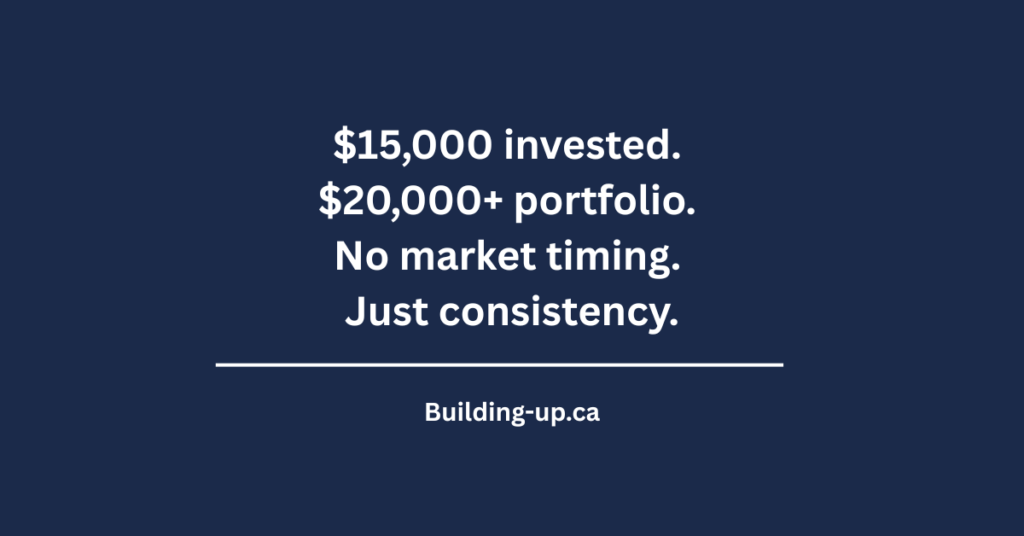
Since then, I’ve invested just shy of $15,000 in book cost. That portfolio is now worth over $20,000. Not because I got lucky — because I stayed consistent, diversified properly, and let compounding do its work.
The Excuse I Hear All the Time — And Why It’s Wrong
Before I get into my strategy, I want to address something I hear constantly from friends and even from older people who should know better: “I wish I could invest, but I just can’t afford to.”
I understand where it comes from. Money is tight for most people in their 20s. But here’s what gets missed: you don’t need hundreds of dollars to start. You can open a Wealthsimple account and buy a fraction of an ETF with $10. Genuinely, $10.
When I started at 18 I was putting in $100 a pay. That’s $2,600 a year. After five years of contributions alone — before any market gains — that’s $13,000. Not glamorous. Not life-changing overnight. But it’s something, and something compounds into a lot more than nothing.
The people who say they can’t afford to invest are often spending $100 a pay on things that return nothing. The amount isn’t the barrier. The habit is.
The Strategy I Use (And Why It Works for Regular People)
I’m not a financial advisor and I’m not going to pretend I have a complicated system. What I have is a simple approach I’ve stuck to for years, inspired by a principle from The Richest Man in Babylon — a book I’d genuinely recommend to anyone starting out. I mentioned it in an earlier post and I’ll keep mentioning it because it’s that good.
The core idea: pay yourself first. Before bills, before spending, before anything — a percentage of every paycheque goes directly into your investments. For me that’s at least 10%, which works out to roughly $180 every two weeks, sometimes $200 when I have a bit extra.
I’m not maxing my TFSA contribution room every year. I know people who do, and that’s great — but it’s never been realistic for me and probably isn’t for most people in their 20s. What matters is consistency, not the amount.
Here’s the specific approach I use:
I’ve chosen 10 stocks I want to hold long-term. My goal is to build each position up to a $2,000 book cost — giving each stock a 10% weight in my overall portfolio. No single position can sink me. If one stock has a bad year, the other nine prop the portfolio up.
Once I hit $2,000 in a position I continue adding to it steadily over time — particularly when dips occur, so I can dollar cost average down and improve my overall book cost without overextending myself.
This structure came directly from the Algonquin lesson. When one stock represented too much of my portfolio, one bad run of events nearly wiped out years of contributions. Now, no single stock has that power over me.
This keeps me focused. I’m not chasing every new opportunity or spreading myself too thin. I’m building slowly, deliberately, and letting compounding do the heavy lifting.
What I Actually Hold in My TFSA
My portfolio is roughly split across three types of investments:
ETFs (Exchange-Traded Funds) These are the foundation. ETFs give you instant diversification — you’re buying a basket of stocks rather than betting on one company. For anyone starting out, a broad market ETF like XEQT or VEQT is one of the simplest and most effective things you can hold in a TFSA. Low fees, automatic diversification, and you’re essentially betting on the market as a whole rather than individual companies.
Dividend Stocks (Blue Chips) These are my steady eddies. Think established Canadian banks, utilities, and large companies that have paid reliable dividends for decades. They’re not going to double in a year, but they’re also not going to collapse overnight. The dividends get reinvested and the compounding effect over time is significant — especially inside a TFSA where those dividends are tax-free.
Growth Stocks A smaller portion of my portfolio sits in higher-risk, higher-reward growth stocks. Shopify is one I hold — a Canadian success story and a company I believe in long-term. Growth stocks can be volatile and they’re not for everyone, but at my age with a long time horizon, I’m comfortable holding some exposure to them alongside my more stable positions.
The balance between these three gives me stability, income, and growth potential. It’s not a perfect system, but it’s one I understand and can stick to.
Why Self-Directed Beat Managed for Me
When I was with RBC’s managed service, I was paying fees I didn’t fully understand on returns I couldn’t control. The management expense ratios (MERs) on managed funds can quietly eat 1-2% of your portfolio every year — which sounds small until you compound that over 20-30 years.
Wealthsimple’s self-directed account charges $0 in trading commissions on Canadian stocks and ETFs. That alone changes the math significantly over time.
Beyond the fees, going self-directed forced me to actually learn. When it’s your money and your decisions, you pay attention. You research. You understand what you own and why. That education has been worth more than any managed return.
If you’re newer to investing and not ready to go fully self-directed, Wealthsimple also offers a managed option (Wealthsimple Managed) that’s cheaper than the big banks and still gets your money working. It’s a reasonable stepping stone.
For the basics of getting started with investing in Canada, check out my Investing: Your Simple Guide to Getting Started.
The Numbers That Actually Matter
Here’s a simple way to think about why starting early and being consistent matters more than the amount:
If you invest $180 every two weeks from age 21 to 65 — roughly $4,680 per year — and average a 7% annual return (a conservative long-term market average), you’d end up with approximately $1.3 million.
If you wait until 31 to start the same contributions, that number drops to around $650,000.
Ten years of waiting costs you roughly half your outcome. That’s the power of compounding — and it’s why the TFSA, used properly and started early, is one of the most valuable things a young Canadian can have.
Practical Steps to Actually Use Your TFSA Properly
If you’re reading this and realising you’re not getting the most out of your TFSA, here’s where to start:
1. Check your contribution room Log into your CRA My Account to see exactly how much room you have available. Your limit is cumulative — any unused room from previous years carries forward.
2. Move from savings to investing If your TFSA is sitting in a high-interest savings account, consider whether that money should be working harder in an ETF or a dividend stock. Savings accounts have their place for short-term money, but long-term money should generally be invested.
3. Open a self-directed account if you’re ready Wealthsimple is where I’d point most people starting out — no commission trades, a clean interface, and a managed option if you’re not ready to go fully self-directed yet.
4. Pick a contribution habit you’ll actually stick to Whether it’s $50 a paycheque or $500 a month, the amount matters less than the consistency. Automate it if you can so you never have to think about it.
5. Choose investments you understand Don’t hold something because someone on Reddit told you to. If you can’t explain what a company does and why you own it, that’s a problem. Start simple — a broad ETF is a perfectly respectable long-term strategy.
The Bottom Line
The TFSA is the best financial tool most young Canadians are underusing. It’s not complicated — but it does require you to actually engage with it rather than treating it as a place to park money and forget about it.
I started at 18 with $100 a pay. I had to empty the account when life got expensive. I held a stock through a 60% loss and eventually sold it five years later. I’ve made plenty of mistakes.
But I also kept going. And now I’m sitting on a portfolio worth over $20,000 on $15,000 invested — tax-free — with a strategy I understand and can actually stick to.
The lesson isn’t that I’m particularly clever. It’s that starting matters more than the amount, consistency matters more than timing, and diversification matters more than picking the right stock.
Start where you are. Contribute what you can. Don’t put all your eggs in one basket. And whatever you do — don’t wait until you can “afford to.” You can afford to start with $10. The best time was ten years ago. The second best time is now.
Good luck, get started, and I’ll see you next week!
Alex.
I’m not a financial advisor. Everything in this post reflects my personal experience and approach. Before making investment decisions, do your own research or speak with a licensed financial professional.
Want to go deeper on Canadian investing and accounts? Read my TFSA vs RRSP guide to figure out which to prioritise, or check out the FHSA if you’re saving for your first home.

 English