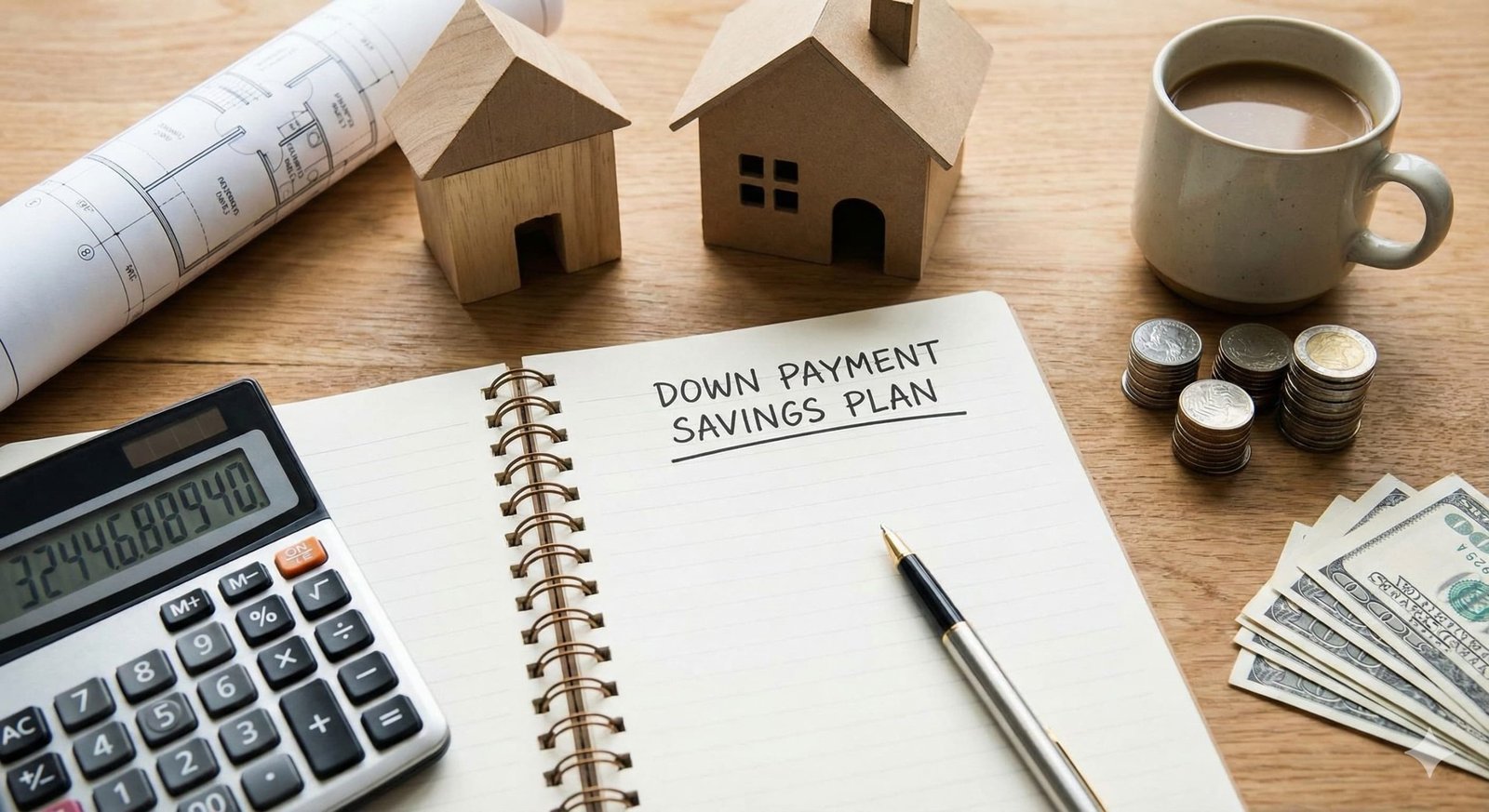
Down Payment Savings Plan: The Non-Negotiable Guide to Hitting Your Goal
The first piece of advice you get when you mention buying a house is always the same: “Just start saving.” If I had a dollar for every time I heard that, I might have paid off my mortgage already. Those same people who are shocked that you haven’t saved enough for your down payment yet are the same who paid a fraction of what you will have to pay today to purchase a home. You know as well as I do that there is more to it than “just saving”; you need a real game plan, and a hype man (hopefully that can be me!)This isn’t a fluffy motivational speech. This is the Down Payment Blueprint—the exact, non-negotiable strategic plan we used to go from dreaming about a house to actually closing on one here in Canada. This blueprint is broken into four actionable parts. If you’re ready to stop feeling trapped and finally hit your down payment savings plan goals, then keep reading.
Part 2: The Two Pillars of Down Payment Savings Plan
There were two main pillars of savings that I used when saving for a house and anything else big that needed a larger sum of money. I used these same principles when saving up for my new car, for paying for my university tuition each year, and even now as I look at what my next savings goals are. Those pillars are Aggressive Cutting (reducing expenses) and Accelerated Earning (increasing income).
Pillar 1: Aggressive Cutting (The Deep Dive)
Aggressive Cutting is exactly as it sounds, but you need to go far beyond the easy wins. You need to go beyond shopping at Walmart instead of Sobeys, or eating in instead of going out. When we were saving for our house, we did almost nothing for roughly 10 months.
Don’t get me wrong—we still set aside a few hundred dollars each month to go out for a meal every once in a while or hang out with some friends. If you restrict too much, you will be miserable; however, if you strike just the right balance, you will meet your goals.
The “Snowball” of Savings:
- Social & Entertainment: We significantly cut back on going out with friends.
- Health: We cancelled gym memberships and switched to working out at home.
- Transportation: We carpooled to places when we could, such as going to work with her parents in the morning instead of driving ourselves.
- Subscriptions: We further reduced our phone bills and changed credit cards to have no monthly fees.
- Groceries: We changed our diets to focus on an 80% plant-based meal plan during the week. This was really tough, but the result was worth it: we used to get groceries for the two of us for an incredible $50-$60 a week.
All these seemingly minor cutbacks you think won’t make a difference will snowball into something larger. The reward in the end was worth it because we accomplished our down payment savings plan way faster than we could have ever imagined.
Pillar 2: Accelerated Earning (Working Smarter)
On the side, I’d do odd jobs with friends or family members to bring in a bit extra here and there, as well, to top up our accounts. With both these pillars propping you up, you’re bringing in as much money as you can each pay and reducing your overall expenses. Maximizing the money you can put into your savings accounts for this goal is non-negotiable—and trust me, the cost of homes and everything else these days requires you to do just that.
Accelerated Earning points to working as much as you possibly can (within reason) to maximize your take-home pay. This is the turbocharger for your savings goals.
Both Rachel and I picked up overtime shifts at our jobs; she even took on two extra jobs to catch up to me on our savings plan. I had started saving slowly for a house since I was 18, knowing it was something I wanted, and she wanted to be right there with me.
On the side, I’d do odd jobs with friends or family members to bring in a bit extra here and there, as well, to top up our accounts. With both these pillars propping you up, you’re bringing in as much money as you can each pay and reducing your overall expenses. Maximizing the money you can put into your savings accounts for this goal is non-negotiable—and trust me, the cost of homes and everything else these days requires you to have a solid down payment savings plan.
Part 3: Leveraging Registered Accounts (The Tax Advantage for your Down Payment Savings Plan)
There are also some accounts and benefits that are offered by financial institutions that will significantly help you on your way to meeting your down payment savings plan goals. These tax-advantaged accounts aren’t just savings tools; they are powerful government programs designed to accelerate your first home purchase. The main two are the FHSA (First Home Savings Account) and the RRSP Home Buyers’ Plan (HBP).
The FHSA: The Best New Tool for First-Time Buyers
The FHSA is a game-changer. It’s a tax-deductible account, similar to an RRSP, with the added benefit of tax-free growth, making it truly the best of both worlds.
The FHSA Blueprint Rules:
- Contribution Limit: You can deposit up to $8,000.00 per year into the account.
- Lifetime Max: The total amount you can contribute is $40,000.00 (across a maximum of 5 years).
- Rollovers: Any unused contribution amounts roll over into subsequent years.
This was especially helpful for us. When I first opened this account upon its release in 2023, I was just finishing university and knew I’d be making more money in 2024, specifically because I was leaving school and could finally maximize my income working full-time for the year. This was part of our Accelerated Earning strategy from Part 2. I focused on saving the initial $8,000.00, and when January 1, 2024, arrived, I immediately transferred that money in and slowly picked away at my new $8k contribution room.
The Tax Benefits: The money you put in is tax-deductible (meaning a tax credit at the end of the year), and any profit made in the FHSA is also tax-free when withdrawn for a home purchase. It’s simple, but the only stipulation is that you must use the money towards the purchase or related expenses of your first home within 15 years.
Key Tip: Each person can have this account, so both Rachel and I utilized one, maximizing our tax benefits and savings potential.
The RRSP Home Buyers’ Plan (HBP): The Interest-Free Loan
The HBP is a bit trickier, but it’s still an excellent option if you already have money in an RRSP.
The HBP Blueprint Rules:
- The Loan: You can withdraw money tax-free from your RRSP to use toward your down payment.
- The Catch: The amounts you withdraw must be repaid into the RRSP account within 15 years.
- The Plus Side: It’s essentially an interest-free loan from yourself. For example, if you take out $30,000.00, this amount needs to be put back within 15 years, but there is no interest or extra fees for “borrowing” the money. Failure to repay will result in taxable consequences.
Both savings types are great as they force you to set money aside in a different account, locking it into the house savings goal. It almost forces you to stick with your down payment savings plan, and is a really good incentive to keep going. The money you put into these accounts also doesn’t just sit there—it can (and should!) be invested. For the specifics on how to actually grow the cash inside these accounts, check out my full guide on getting started with investing. Investing: Your Simple Guide to Getting Started
Part 4: The Automated Blueprint for Your Down Payment Savings Plan
I personally really like routines and automatic savings tools because they completely remove the temptation to spend money. Plus, you almost forget that the automatic deposits are coming out, and before you know it, you have a nice little honey pot all saved up!
The Set-It-and-Forget-It Power
For me, the power of automation was the key to hitting my goals with our down payment savings plan. I transferred a small amount—$50 to $100—every two weeks for roughly $2.5$ to $3$ years. The result? When we bought our house, I had an extra $8,500.00 set aside that I had more or less forgotten about.
I even use this principle now with my RRSP as a tax credit strategy for the end of the year. I currently put $50 bi-weekly into it, totaling over $1,350.00 annually (plus investments, putting it closer to $1,400.00). This will help me come tax time, and it’s something I don’t really notice throughout the year.
The Psychological Trick: Segmented Accounts
I myself have a few different segmented accounts now—one for my bills, regular savings, tax savings, a chequing account as a sort of in-between holder, and a long-term savings account with my TFSA. The same principle applies to any major goal and can help you meet your goals easily without thinking too much about it.
Separating your regular spending money and your dedicated savings is crucial from a psychological standpoint. It’s hard to maintain your savings goals when all your money is together. The constant questions—What are you allowed to spend? How much are you into meeting your goals? What can you spare towards something else?—make saving much more difficult.
The Blueprint Action: Create a separate, dedicated “Home Fund” account and send your auto payments there. This money is untouchable. You can even use your FHSA or other registered accounts (from Part 3) as your dedicated “locked” savings pot.
Conclusion
Now you know my secrets, it’s time for you to implement them.
Anyone can save for a down payment. Some of it is luck, but a large part of it is strategy. We’ve laid out 4 main components: knowing your numbers, optimizing your income and expenses, leveraging government tax advantages, and automating the entire process.
If you follow this plan, it won’t happen overnight, but give it 6-9 months and you will truly start to notice the impact of your continuous deposits, and stop feeling trapped in the endless cycle and take strategic control of your down payment savings.
Cheers for reading, and if you want to see how I put this into practice for myself in buying my first home, check out my last post here: First-Time Buyer: 10-Step Plan for Buying Your First Home
Until next time.
Alex.

 English